
Buddhist Feminism
1984 - Sri Lanka

In 1983, after graduating from Oberlin College, my now wife and I applied to the Shansi Memorial Association for fellowships to work in Japan and Sri Lanka, respectively. We thought one or the other would get a fellowship, and the other would follow, but we both got them. I spent 1983-1985 working for the Buddhist development organization Sarvodaya Shramadana.
In 1984, while working for Sarvodaya, I was approached by an abbot from their center, which was training monks to set up preschools and clinics. He wanted to encourage Sri Lankan boys to temporarily ordain, which was not a customary practice in Sri Lanka, unlike in Myanmar and Thailand. I was happy to ordain for four months, and divided my time between meditation retreats and writing exegeses on Buddhist politics. I wrote this essay on Buddhism and feminism during that time.
When I got to Japan and was hanging out with Buddhist scholars, I was embarrassed about the hermeneutical frame I used in the piece. At this point, I believed Buddhism had a thread of pure, radical democracy that I could discern in a feminist tradition in one place, a socialist text in another, all connected by "real dharma." The actual scholars I met, some of whom worked on the complicity of Zen in Japanese fascism, convinced me that the better approach, and in fact the more Buddhist approach, is not to assume that there is a "real Buddhism." Buddhism has a range of social ethics, and is, on average, less patriarchal and classist than most faiths, but has also been used to justify genocides, slavery, and patriarchy. The doctrines of some Buddhisms are in direct contradiction to those of other Buddhisms.
Today, when I write about Buddhism, I try to avoid essentializing Buddhism and its social ethics. I will stand by some propositions about Buddhism and women, however. Women have generally fared better in Buddhist societies than in neighboring non-Buddhist ones. Unlike most faiths, Buddhism does not consider marriage and childbearing a religious obligation, and Buddhism was the first Indian religious order to give women the option of ordination. More philosophically, although Buddhists are often not clear on this point, we don't have essential genders since we don't have essential selves. (BTW a shout out for the Thai TV show Khemjira, in which two men are reincarnates of former lesbian lovers, and the male protagonists are reincarnates of a heterosexual couple. Given the gender swapping of reincarnation, Hindus and Buddhists have had to strenuously avoid pansexual conclusions for a very long time.)
A version of this essay was published by the Buddhist magazine Spring Wind in 1986, and again by the Buddhist Peace Fellowship in 1999.
In the 40 years since I wrote this there have been a lot of Buddhist feminist scholarship. If you are interested in the topic, these are some recommended texts:
Women in Buddhist Traditions by Karma Lekshe Tsomo (NYU Press, 2020) A clear, comprehensive primer on Buddhist women's histories, practices, and strategies for challenging patriarchy across regions—excellent as a first entry point.
Buddhist Feminisms and Femininities ed. Karma Lekshe Tsomo (SUNY Press, 2019) An accessible anthology that brings multiple Buddhist traditions into conversation with feminist theory; good for seeing the field's diversity and debates.
Buddhist Feminism: Transforming Anger against Patriarchy by Sokthan Yeng (Springer, 2020) A philosophical bridge text that shows how feminist and Buddhist ideas can mutually inform critiques of patriarchy and practices of liberation.
I have a couple more pieces of juvenilia from my exegetical period that I could share if folks are curious. One is the first paper I wrote in graduate school, an empirical case study of two monasteries through the Gramscian lens of some monks being "organic intellectuals of the working class." Let me know if you want to see them. citizencyborg@gmail.com
Buddhism is radically liberating for women. Yet Buddhism as a historical institution reflects both 2500 years of men's power over women, "patriarchy", and women's struggle for empowerment. One can find within the Buddhist tradition women who prefigure modern feminism by two and a half millennia, and yet writings which equal the worst anti-woman polemics of any religion.
The liberative project of dharma-practice, as opposed to historical Buddhist culture, is intrinsically opposed to patriarchy. Patriarchy, as a limitation on human potential, is rejected by those who break through habitual, socialized thoughts and behaviours. Patriarchy, as the institutionalization of violence against women, is rejected by those who practice peace. Patriarchy, as the proprietary relationship of the sexes in the patriarchal family, where men own women's sexuality, their labor-power, and children, their product, is rejected by those who eschew the illusion of self in property. Throughout history, spiritual radicals have been driven from everyday patriarchal society, "the householder life", into radical sexual alternatives such as celibacy.
Early Buddhism's influence on the position of women was historically progressive. The Buddhists and their contemporaries, the Jains, were the first Indian mendicant orders to admit women, thereby greatly expanding women's social options. Women in 500 B.C. India had no property rights, no control over their household affairs or choice of husband, and from 500 A.D. until the 1900s, widows were sacrificed on their husbands' funeral pyres. The brahminical caste-system was strongly patriarchal, as summed up in this phrase from the laws of Manu:
Their fathers protect them in childhood,
their husbands protect them in marriage,
and their sons protect them in age;
a woman is never fit for independence.
(quoted by Khantipalo)
The system was especially constraining for upper-caste women, from whose ranks many of the early Buddhist Sisters came. Many of the early Sisters were also from aristocratic republics, such as the warrior clan of the Shakyan people from which the Shakyamuni Buddha came. As the expanding imperialist monarchies slowly absorbed these republics, as were the Shakyan kingdoms during the Buddha's lifetime, the democratic rights of noble women were further constrained. [As Goonatilake (1982) points out, during the pre-Brahmin Vedic period, women were more equal with men in marriage, education, and access to the practice of religion.
At this time of great social change, some strong, independent women renounced society and became wanderers, such as the Buddha's ex-wife, Yasodhara, who decided to follow the example of her ex-husband. After he left, she shaved her head, donned patchwork robes, and ate one meal a day from a bowl. (Later, she became a nun and attained Enlightenment.) But these women mendicants were not widely accepted. By providing a culturally approved alternative to marriage, the Sisterhood made freedom from the patriarchal family widely available. Young women were given leverage over their fathers' choice of husband: choose well, or I'll become a nun!
The Buddhist Sisterhood was India's first "women's space", a life separate from, if somewhat subordinate to, monks, who wandered, studied, and meditated in the company of other women, free from the restrictions of children and family. The Sisterhood was an option for those strong, intelligent women for whom the patriarchal family would have been stifling, or "women-identified women" who today might become lesbians, or women with strong introspective personalities, or simply women whose situation in lay life would be otherwise bleak, such as widows, spinsters, or abandoned wives.
Although the Buddha had admitted several of these wandering women ascetics to his Order before he established the Sisterhood (Byles), he formally created the new Order only after being approached by a delegation of women from his warrior-caste Sakyan clan, headed by his aunt and stepmother, Mahapajapati Gotami. These privileged women had cut their hair, donned robes, and walked 200 to 300 miles to ask admission to the order. They arrived crying, covered with dust and with swollen feet. The Buddha refused three times. Then the Buddha's closest disciple, Ananda, taking pity on the women, interceded and asked directly if women could attain Enlightenment. The Buddha acknowledged that they could and subsequently created the Sisterhood.
Women are capable, after going forth from the home unto the homeless life under the Dhamma set forth by the Tathagata (the Buddha), of realizing the Fruits of Stream-winning, Once-returning, Never-returning and Arahantship (the four stages of Enlightenment)
Yet he predicted that the Dharma and the Sangha would decline twice as fast, in 500 years rather than 1000, and he laid down eight rules to stem the tide of degeneration.
1. All nuns, no matter how senior, must bow to all monks, no matter how junior.
2. Sisters shall not spend the rains-retreat in a district where there are no brothers.
3. The bi-weekly meeting for the reciting of the code of conduct shall be set by a brother, and a sermon preached at these meetings by a brother.
4. Sisters must invite criticism at the end of the rains-retreat from both the Brotherhood and Sisterhood.
5. Sisters guilty of wrong-doing shall do penance to both Orders.
6. A Sister may take full ordination after observing the major vows for two seasons.
7. Sisters may not speak among brothers, though brothers may speak among Sisters.
These rules have strongly suggested an anti-woman streak in the Buddha, especially in light of the even more misogynistic writings in later Buddhist scriptures. But the revolutionary nature of this innovation, in its context, suggests quite the opposite. At the mundane level, Buddha was taking the risk that all celibate orders of both sexes run, of being slandered as "free-lovers", and indeed the Buddhist scriptures recount that the nuns were slandered in this way. On a larger scale, the Buddha's prediction that the Dharma and Sangha would eventually decline can be seen as a recognition that the integration of Enlightenment into the world, which the interdependence of Sangha and laity represented, would eventually end in a new status quo. The more revolutionary the institution, the more hostility from the "powers that be", and the sooner racist, castist, patriarchal society would storm the "dharmadhatu" ("dharma fortress"). In a sense, the eventual elimination of the Sisterhood in most Buddhist countries represents a diminution of true Dharma, patriarchy's cooptation of the revolution, and these rules are an avoidance of the "infantile disorder of ultra-leftism", radical extremism.
It doesn't matter whether this was the intent of the Buddha or not. Scriptures can be a deadly trap if we are attached to them, rather than holding on to our own analytical and experiential understanding, as the Buddha warns in the Kalama Sutta. A feminist perspective can be derived from an analysis of one's experience, the most basic "principle" in Buddhism. A Buddhist does not have to find feminism in the scriptures any more than she has to deny modern astronomy and search for the mythical Mount Meru at the center of the world.
On the other hand, if we have faith that a radical experience of Insight was passed down from the Buddha, it is essential to examine the scriptures for the influence they had on Indian women before setting them aside. Indeed, an examination of the early Buddhist scriptures provides considerable evidence of how women's power and feminist analysis were articulated in early Buddhism.
For instance, several nuns and laywomen were among the Buddha's most able and wise disciples. Theri (Sister) Khema, a former slave, was worshipped by King Pasenadi after she had taught him about the concept of non-existence after death. The unshrinking Punnika Theri, another former slave who her master had freed so she could become a nun, once lectured to a brahmin:
O ignorant of the ignorant who has said that one
is freed from evil karma by water baptism? If this
is so, all the turtles, frogs, serpents and crocodiles
will go to heaven!
Two serious offences in the monastic code require lay women to act as judges of a monk's guilt if he is seen in suspicious encounters with other women. The Buddha enjoined that young boys need both parents' permission to ordain, which contravened the supremacy of the father. Buddhism does not stigmatize widows and allowed them to remarry.
One of the few scriptures specifically given to laypeople is the Sigalovada Sutta, an excellent example of how the Buddha reinterpreted traditional Hindu-Brahminical ideas. In it, he advises a boy not to make sacrifices to the gods of the six directions, but rather to regard six social relationships (between parents and children, teachers and students, husbands and wives, friends, employers and employees, laity and renunciates) as the six directions, worthy of the worship of fulfilled responsibility. It was a relatively new idea at the time that a husband had as many responsibilities to his wife as she had to him: 1. to show her respect, 2. to show her compliance, 3. not to commit adultery, 4. to leave her in charge of her sphere, 5. to supply her with finery. By elaborating these sets of interdependent relations, the Buddha pointed away from authoritarian, propertarian relations, where superiors had no responsibility to inferiors, towards a more paternalistic society.
While the Buddha subordinated the nuns to the monks in matters such as paying respects, speaking in public, and the necessity of staying near and being taught by monks, he safeguarded their equality and independence in other areas. When six monks had some of the Sisters wash, dye, and comb sheep's wool for them, causing the Sisters to neglect their meditation, the Buddha made a rule that monks must not have Sisters do such work for them. (Might a modern application be that men should help with childcare at meditation retreats?) After some monks came in a group to visit the nuns, the Buddha established a rule that only one senior monk, chosen by the other monks, would see the Sisters every two weeks for their lecture. Then he was to leave before nightfall. A monk once coerced a nun into giving him her robe, accusing her of selfishness when she protested that the nuns were poorer than the monks. The uproar that ensued when this came to light prompted the Buddha to forbid nuns from washing monks' robes.
Unlike other religious traditions, the segregation of nuns had nothing to do with their impurity. Buddhism does not stigmatize menstruation, for instance. Instead, their separateness was to protect both Orders from falling back into the habitual, patriarchal behavior patterns of lay life, drawn by the powerful magnet of sexual attraction. There is the story of the monk and nun, formerly a man's wife, who were frequently meeting alone. Once they were inspired to expose them- selves to each other and the monk ejaculated on his robe. Then the nun, his former wife, washed his robe for him. The uproar when this came to light caused the Buddha to forbid nuns from washing monks' robes.
By far the most interesting indication of "feminism" in the Buddhist canon, though, is the volume of Buddhist nuns' enlightenment stories, the Therigatha, a companion piece to the parallel collection of monks' enlightenment stories. The author of the Therigatha, Soma Theri, is challenged in another scripture by the personification of illusion, Mara, that women have no capacity for wisdom. She replied:
What should a woman's nature signify when consciousness is strong and firmly set, when knowledge rolls ever on, when she by Insight rightly comprehends the Dharma? Am I a woman (in these matters) or am I a man, or what am I then? Is one who talks like this fit to talk to Mara?
Although the Therigatha contains many verses that emphasize the pessimistic and anti-sensual aspects of early Buddhism, it also expresses an awareness of the unique sufferings of women and the value of monastic freedom. For instance, Kisa-Gotami Theri's verse sings of the pain in women's lives, bearing children, having them die, losing one's husband:
Lowly and destitute by birth,
reborn a thousand times
she (woman) suffered untold sorrow.
The tears her eyes shed were as
boundless as the sea...
Born to a lot so humble,
a target for. scorn, by the
light of truth she won release.
Cutting through the conditions that bind women's potential, the path of liberation removes those hindrances that are a woman's lot. These were not just narrowly interpreted as desires, but also external conditions and exploitation of women's labor, as in Sumangala and Sumangalamata Theris (here merged) songs:
Free! Free! I am from all defilements
from shameless spouse, from pestle and mortar
I'm free.
From weaving harsh rushes which
bruise the fingers, from reeking smells of
stale cooking pot.
Free! Free!
Am I so wonderfully free!
From ploughshare, sickle and mammottee
from those three crippling things am I free,
so well am I freed, so free.
Split, split, as the rushes did break
I have so well destroyed lust and hate.
In reverence I sit by root of tree,
I say "Oh this indeed is peace" as in
quietness I meditate.
Oh happiness! Now here I'll stay, just here.
No drudgery of toil for me, no drudgery ever!
Sumangala, now meditate!
Sumangala, now meditate!
Sumangala, delay not, now- live!
The importance of the Sisterhood as an alternative to arranged marriage is portrayed in the story of Isidasi Theri, which begins with two nuns of royal birth sitting by a river after finishing their alms food.
Of the two, more beautiful was Isidasi,
the other, the pious Theri Bodhi,
both learned, skilled in meditation,
from every fetter free.
Theri Bodhi enquired what had made Isidasi...
Turn away from home and hearth?
Seated solitary in the shade,
Isidasi, who could with skill preach the Truth
...explained that she had been given by her beloved father to a wealthy suitor, and had lived as his obedient wife. Though she had served him and his relatives attentively and humbly...
with harsh and angry words
my husband would always address me.
Her husband finally left her. When her husband's parents asked him what she had done, he said she was not at fault and that he simply did not love her. Thereafter, her parents gave her to a second nobleman.
For a month I lived as a slave in his house
attending on him devotedly. Yet he too drove
me away.
After that, her father enticed an ascetic monk to marry her, but he only stayed two weeks before taking again to his robes and begging bowl. Understandably depressed, Isidasi felt her only options were suicide or the Sisterhood.
Then one day, on her way for alms,
the noble Jinadatta stepped into my home.
A nun so pious, so full of poise,
who observes so well the vows
who is wise.
Isidasi offered her alms and then respectfully requested admission to the nun's order. When her father protested, pleading with her to stay and suggesting that she offer alms to the monks and nuns instead, Isidasi proclaimed her independence.
I alone will bear myself the
consequences of my deeds.
With her parents! blessing, then she ordained, and achieved deep knowledge and calm in 7 days.
To modern feminists who have grown up in an era of relative sexual freedom it is difficult to understand that till the present virtually the only way a woman could be free of being a sex object for males was to renounce sexuality altogether. As this song from the Therigatha illustrates, the Buddhist teachings helped empower women to cut through the tangle of humiliating sexuality.
Mara (Illusion):
You who are so young, so lovely
seated beneath sal tree with blossoms crowned
so aware of your loneliness.
Do you not tremble when seducers come along?
Nun :
Though men like you, seducers,
a hundred thousand should approach,
no single hair of mine will turn
Nor will I quake with fear.
And so, tempter, coming all alone,
of what effect are you?
I who possess super-normal powers
can make my form disappear.
Between your eyebrows or your belly,
I could lodge and stay.
How then, Mara, could you see me...
Know tempter, I have triumphed over you.[1]
The Sisterhood was, in fact, a direct affront to male control and appropriation of women's sexuality. A nun was a woman who had resigned from the sex trade, and nuns were consequently the focus of even more unpleasant sexual attention than lay women. After the rape of the highly respected and eventually enlightened nun, Uppalavanna, the Buddha forbade nuns to live alone in the forest, and the rules of the Sisterhood enforced an even more corporate life than that among the monks. A nun had always to have a nun companion, and wake up within an arm's length of another nun. Though the nuns and monks' communities were separate, nuns were to spend their 3-month rains retreat near a monks' community, partly for protection against molestation.
The frustration some men felt when confronted by nuns' disinterest in the patriarchal sex game is apparent in the story of Subhi Theri, who was waylaid by a "seducer" while walking through the forest. He spoke lovely verses, attempting to convince her of the folly of renunciation for one so young and beautiful. Still, she remained firm in determination and counseled him to lay aside his lust. Reminding him that her body was made of elements, doomed to decay and death, transient, intangible, an illusion, she inquired what was so attractive to him. After he had praised her eyes, she plucked them out and gave them to him, frightening him away. While this may provide a whole new meaning to Christ's injunction "If thine eye offend thee pluck it out", some may feel that rather than suggesting self-mutilation as the correct response to sexual harassment, it does. Sister Subha should have threatened to pluck out his eyes instead. The Zen approach certainly seems to be different, as in this story of 1331 A.D. Japan:
....when Nitta Yoshisada was fighting against Hojo Sodatoki, the chief retainer of the Hojo family, named Sakunda Sadakuni, was slain.. His wife, Sawa, wished to pray for the dead man; she cut off her hair and entered Tokeiji (monastery) as the nun Shotaku. For many years, she devoted herself to Zen under the 17th teacher at Enkakuji, and ultimately became the third teacher at Tokeiji. In the Rohatsu (meditation intensive) training week of December 1339, she was returning from her evening interview with the teacher at Enkakuji, when on the way a man armed with a sword saw her and came to rape her. The nun took out a piece of paper and rolled it up, then thrust it like a sword at the man's eyes. He became unable to strike and was completely overawed by her spiritual strength. He turned to run and the nun gave a Katzu shout, hitting him with the paper sword, He fell and then fled. Zen student's Test: Show the paper sword which is the heart sword and prove its actual effect now. (Ling, 1976).
Three hundred years after the Buddha, the Indian Buddhist monarch, Asoka, had sent his son, the monk Mahinda Thera, on a mission to the Lankans. Seeing that the sister-in-law of King Devanampiya Tissa was practicing with several other Sri Lankan women as ten-vow novices, and in need of full ordination, Mahinda sent for his sister, the nun Sanghamitta. Comforting her father, Asoka, on the loss of son and daughter, Sanghamitta said:
There are holy women impatient for my coming, waiting
to receive the ordination, so I must hearken to the
call, and we are both sufficiently brave to bear the.
parting, my father, when it is my duty that commands me.
Embarking with a sapling of the Buddha's original Bo tree, the descendant of which still grows today in Anuradhapura, tended by 10-vow nuns, Sanghamitta imparted the higher ordination in Lanka. The Lankan Sisterhood was said, probably exaggeratedly, to have reached ninety thousand nuns not many years later. This fully ordained line eventually died out in all Theravadan countries (that is, Burma, Sri Lanka, Thailand, and Cambodia). However, it was passed to China when a delegation of Lankan nuns learned Chinese and went to instruct Chinese nuns in orthodoxy. Although this order of fully ordained nuns still exists today in Taiwan and Hong Kong, these nuns are Mahayanaists and thus not accepted as legitimate by the Theravadans. Secondly, they no longer practice the double. Ordination into both the Brotherhood and Sisterhood, rather than being newly ordained each generation by monks, occurs without having an independent lineage. Though more than 100,000 "nuns" exist today in Buddhist countries, the vast majority of them are technically only 10-vow novices with very little prestige.
It is interesting that "nuns" and lay-women's energies in Theravadan countries are usually focused on devotional rituals and shrines, such as the Bo-tree at Anuradhapura. Conversely, in the Mahayana tradition, where the "devotional aspect has been integrated with the core doctrine, rather than being a secondary, inferior pursuit, the nuns' order has been comparatively more successful. Monks frequently attribute the decline of the Sisterhood to women's weakness for devotionalism and emotionalism, and men's alleged preference for meditation and discipline, though we should remember mystic Simone Weil's words when Buddhist monks teach us history:
History therefore is nothing but a compilation
of the depositions made by assassins with respect
to their victims and themselves.
(Weil, p. 225)]
Alongside the generally liberative strain, there developed in Buddhism a patriarchal strain which reflected the pattern of the outside world This included the appearance of the notion that women cannot attain Enlightenment, but must die and be reborn as men; a doctrine flatly contradicted by the Buddha and the early enlightenment stories, though there is a sutra which suggests that women cannot become Buddhas (Anguttara, I, p.28,9-19). The negative strain of Buddhism emphasizes that women cannot attain Enlightenment since they are by nature lustful, clinging, devious, weak-minded, and feeble, born to this miserable condition because of their wicked past karma. In later literature on the Buddha's past lives, the Jataka Tales, women are often portrayed in an unflattering manner, with many being responsible for hindering or seducing away the Enlightenment-seeking male. Buddha is never portrayed as having taken a woman's form.
The scriptures hold up the man who abandons his wife and family in his monastic search for personal fulfillment as faultless; in fact, the Buddha abandoned his wife shortly after she gave birth to their first son, whom he named "Rahula," meaning "bond". Some of the early nuns were the ex-wives of men who had left to become monks, sometimes after violent arguments. In a previous life, the Buddha had given away his wife and children to a wicked brahmin as an act of renunciation. Much of the negative tradition emphasizing women's seductive natures can be attributed to monks not being very well grounded in self-understanding and blaming external forms for the desires that arise within them. (I couldn't help raping that woman, your honor, when she wore such sexy clothes...) If women were more manipulative, it is understandable, given that interpersonal power was the only avenue open to them.
A slightly less oppressive notion was that women could attain Enlightenment, but only after changing into a man according to the formula "their female organs disappear and male organs appear" (see Paul, 1979). In a sense, the nun's discipline was less a means to get back to the androgynous Void beyond sex differences than it was a way to become more like men and overcome their female karma.
Obviously, women do have different karma than men; karma here understood as those limiting conditions which obscure our inner wisdom, which tend to manifest as habitual tendencies of thought, speech, and behavior, or as external circumstances, and which we are partly responsible for because of our past actions. The question is, what precisely is the nature of "woman's karma" and how is she responsible for it? If one says that karma consists of women's weaker bodies, minds, or lack of spiritual capacity, one falls into the misogynist trap. Certainly, Buddhists should acknowledge that women have a more difficult life with family burdens and disempowering socialization. But the Buddhist path does not tell the oppressed that there is nothing they can do about their situation since it is the result of their past actions. Instead, our unwillingness or lack of determination to liberate ourselves in the past has contributed to the oppression we face now, and it's about time we seized the moment and took responsibility for our lives. The handicap is not knowing how to deal correctly with our karma, not the karma itself.
For instance, Buddhism displays a certain ambivalence about the Mother: on the one hand, mothers are said to have strong karma holding them back from Enlightenment because of their attachment to their children. Yet Buddhist scriptures recommend that one meditate on compassion by reflecting that in some previous birth each of us has been the mother of every other one of us, and that we must have the same love towards all beings that the mother has for her child, whom she would sacrifice her own life for. (This issue is parallel to the discussion in the women's movement about whether there are any intrinsic qualities of "womanhood" beyond all the deformed patriarchal programming, or whether humans are basically androgynous, and that this should be our goal.)
Even when the scriptures do not give a negative or inferior cast to femini- nity, and are moderately progressive for their time, they still show a certain contentment with the status-quo position of women, as in the wife's obligations to her husband (Sigalovada and Uggaha Suttas), a wife should rise early and go to bed last, doing all things willingly and with a sweet voice honor all that her husband honors; be skillful in home crafts, oversee the servants and enslaved people in the household; not commit adultery and protect the household monies. Though Buddha says a daughter may turn out to be better than a son (in the Samyutta Nikaya), another sutra points out that wise parents desire sons to keep up the traditions and possess the heritage (Anguttara, III, 36).
Unfortunately, the Buddhist scriptures were not written down until several hundred years after the Buddha's death, having been passed down as an oral tradition; thus, we don't know how much was added by later monks. But only the most ardent apologist will blithely dismiss what she disagrees with as commentary and accept the rest as the Buddha's own words. Really, it is more correct to look at even the earliest Buddhist scriptures as reflections of the total social, intellectual, psychological, and politico-historical phenomenon of early Buddhism, and thus only an indirect reflection of the Buddha himself. In this way, we may honestly hold the perfect wisdom that the Buddha represents aloft from the complex and contradictory body of scripture, and its occasional misogyny.
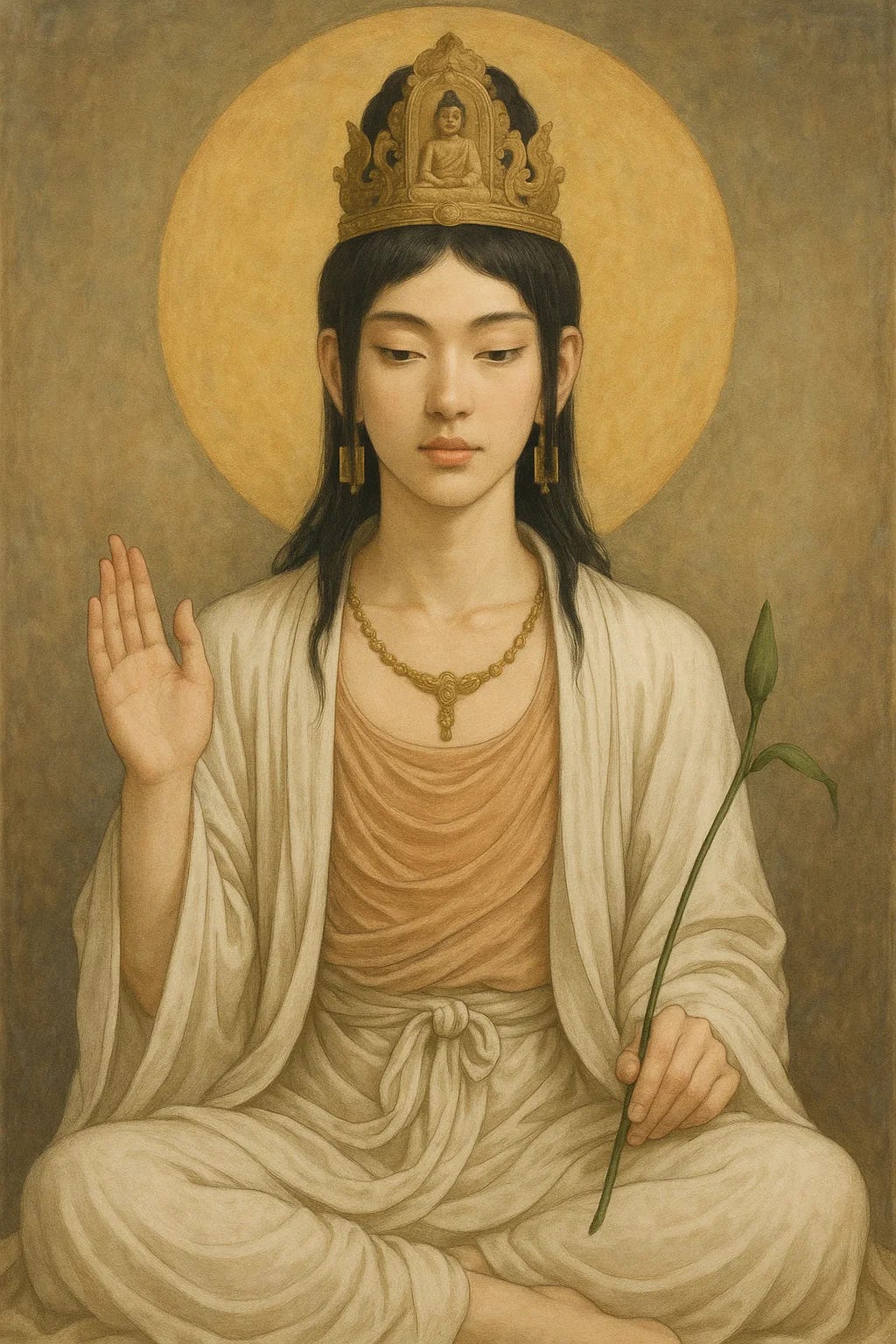
If the slow death of the Sisterhood and the rise of misogyny in Buddhism were indicators of a decline in pure Dharma, and if one is superstitious enough to believe that the Dharma would die after 500 years, then the rise of the Mahayana tradition roughly 500 years after the Buddha can be seen as a fresh awakening of radical Insight which again had consequences for women. The Mahayanaists' creation of a semi-divine pantheon of enlightened beings ("bodhisattvas"), many of whom were female, liberated women in the Buddha realms, if not on earth. The famous Chinese/Japanese bodhisattva Kuan Yin is sometimes depicted as a male, sometimes as a female, and sometimes as androgynous. The chief female bodhisattva of Tibet, Tara, has forms that carry weapons and minister to specific needs, such as removing the fear of tyrannical governments.
The Vimalakirti Sutta, a late Mahayana scripture, provides the most delightful example of the effect of the Mahayana emphasis on Sunyata or "Voidness", and its relationship to sexuality. It is also an important Sutta because the protagonist is a layman whose wisdom and supernatural powers are equal to, and in some cases superior to, those of the Buddha's monks. The following section is an encounter in the sutta between the monk Sariputra (well-respected in the Pali scriptures, but a favorite target for the Mahayanists), encountering a highly enlightened goddess.
Sariputra: Goddess, what prevents you from transforming yourself out of your female state?
Goddess: Although I have sought my "female state" for these twelve years, I have not found it.
Reverend Sariputra, If a magician were to incarnate a woman by magic, would you ask her, "What prevents you from transforming yourself out of your female state?"
Sariputra: Not Such a woman would not really exist, so what would there be to transform?
Goddess: Just so, Reverend Sariputra, all things do not really exist. Now would you think, "What prevents one whose nature is that of a magical incarnation from transforming herself out of her female state?"
Thereupon, the Goddess employed her magical power to cause the elder Sariputra to appear in her form and to cause herself to appear in his form. Then the Goddess, transformed into Sariputra, said to Sariputra transformed into the Goddess, "Reverend Sariputra, what prevents you from transforming yourself out of your female state?"
And Sariputra, transformed into the Goddess, replied "I no longer appear in the form of a male! My body has been changed into the body of woman! I do not know what to transform!"
The Goddess continued, "If the elder could again change out of the female state, then all women could also change out of their female states. All women appear in the form of women in just the same way as the elder appears in the form of a woman. While they are not women in reality, they appear in the form of women. With this in Mind, the Buddha said, "In all things, there is neither male nor female".
(Thurman, p.61)
When the Hindu Tantric tradition began to seep into Buddhism, with its complicated sexual yogas and meditation, it had a radical effect on certain Buddhists' attitude to women. The earthiness and sensuality attributed to women, which the sexist side of Buddhism saw as their spiritual weakness, became a spiritual power in Tantric Buddhism. The female yogi, "yogini", who channels her sexual energy into meditation in the midst of the sex act, was seen as one of the most important teachers a Tantric monk could have (an idea reflected in Herman Hesse's novel Siddhartha). For instance, the Tantric master Marpa and his wife shared "long and highly fruitful relationship" with the consort-guruess Da-me-ma, and the Tantrist Savari was taught by two sisters, Logi and Guni, who, as Tantric consorts, helped him to significant breakthroughs on his path.
In Tantric symbolism, female energy represents perfect wisdom, related to voidness and the womb, while male energy is linked to compassionate action. Implements such as the bell (female) and the lightning bolt (male) were held in stylized forms during Tantric rituals, symbolizing these energies, and during the sexual ritual, the yogi and yogini would meditate on their union as the union of these two principles.
The PrajnaParamita (Perfect Wisdom)
must be adored everywhere
by those who strive for liberation.
Pure she stays in the realm
beyond this empirical world;
In this empirical world
she has assumed the form of a woman.
In the guise of a woman
she is present everywhere...
Woman in all social positions
must never be despised.
A woman is Divine Inspiration.
Only in this world
she has assumed bodily form.
(Guenther, P.83, 1952)
Some Tantric yoginis were royal or upper-caste, but many were also low-caste, while many monks in this period appear to have been upper-caste. Thus, monks involved in affairs with Tantric consort gurus were not only offensive to Buddhist discipline but also to caste-sensitivities. The King Dombhipa was driven from his throne when his twelve-year Tantric relationship with a low-caste woman was discovered. After retiring to the forest to continue their practices, they were finally put to death. When the Indian monk Tilopa, the founder of a great lineage of Tibetan Buddhism, was just a student monk, he was visited by an ugly, old woman who asked if he understood the Dharma. Frustrated, he answered "no", which caused her to dance with glee. Embarrassed, he replied "yes", with which she began to weep. She revealed herself as one of several demonesses whom the Buddha had entrusted to guard special teachings until wise enough people arose to understand them. Throwing respectability to the wind, Tilopa embarked on a journey to the demonesses' realm, engaging all the demonesses and their queen in sexual yoga to win their teachings. After this, he became a social outcast and took a low-caste woman, a sesame-seed-oil ("til") maker, who taught him her trade and from whom he derived his name.
The Tantric Siddha Vajraghanta had a woman liquor-merchant as his consort, with whom he travelled and taught. When the Tantric master Saraha had a block in his practice he met a woman Tantric who was working as an arrow-smith, (Professions such as the making and selling of weapons or alcohol are not considered proper for a Buddhist and are usually pursued by other religious groups or low- caste people in Buddhist societies, yet, the Tantrics took up these professions as spiritual disciplines.) Saraha lived with her as his consort-guru, making arrows, and had many breakthroughs. When the King came with a crowd to criticize Saraha's low-caste liaison, he replied:
I am indeed a Brahmin, and I live with the daughter
of an arrow-smith, caste or no caste: there I do
not see any distinction.
I have taken the sworn
vows of a bhikkhu (monk) and I wander about with
a wife: there I do not see any distinction. Some
may doubt and say, "Here lies an impurity!" but
they do not know.
(Ray in Gross, 1980)
Even the relationship of husband and wife becomes a Tantric practice situation, as in the story of Saraha asking his wife for a radish curry. Before she had returned, he had gone into a trance which lasted 12 years. After he came up from his meditation, he again asked for the radish curry. Informed that radishes were now out of season, he determined to go to the mountains to meditate. Upon hearing this, his wife answered that just removing his body from the world was not renunciation, and his trances had not helped much if, after 12 years, he had not given up his desire for radish curry. Chastened, he achieved a profound enlightenment.
After Tantric Buddhism became institutionalized in Tibet, sexual yogis became rare, and celibate monks again became the norm. But the tolerant attitude towards sexuality remained. As in Freud's notion of infants' "polymorphous perversity", where sexual pleasure has not yet been localized in the genitals but is experienced equally by the whole body, Zen and Tantric disciplines teach one to experience one's senses (including consciousness) fully, without neurotic blocks and limitations. For celibate monks and nuns in these traditions, sexual energy could still be worked with through visualization meditation and yogic exercises, perhaps more powerfully because of their celibacy. By forgoing the socialized obsession with genital sexuality, they more easily opened themselves to a richer moment-to-moment experience of life.
There are probably numerous stories waiting to be rediscovered, or that have been irretrievably repressed, of strange, uppity nuns, with offensive practices and doctrines in Theravadan countries, a weakness for heresies such as Mahayanism, or semi-erotic devotionalism. In contrast, in Mahayanist countries, we might find cults centered around women claiming power as incarnations of female bodhisattvas, or bisexual yoginis dedicated to spiritual androgyny. (Sister Khema points to divisions between orthodox and liberal nuns during the Anuradhapura period, during which Tantric ideas were known and had some following in Sri Lanka. It was nuns from the Tantra-sympathetic Abhayagiri Vihara who went to China to ordain nuns there.)
In Tantra, the highest states of Enlightenment are represented by the sexual union of two deities, both of which the meditator identifies with, reminiscent of Jung's male and female archetypes present in every psyche. Homosexuality in the male Sangha has been known since the earliest days, and there are disciplinary rules against the intentional emission of semen (as in masturbation) and in penetration of the penis into any animal or human orifice, "the depth of a sesame seed". Though lesbianism is not (to my knowledge) explicitly discussed in Buddhist scriptures, there were undoubtedly numerous cases dealt with in the history of the Sisterhood. (We might reflect that today, especially in the West, where homosexuality is rapidly becoming a legitimate lifestyle, there are fewer reasons for a rigid segregation of the sexes in celibate communities.) An example of a wildly unconventional and very earthy, celibate saint is the revered Tibetan saint Milarepa, a hermit who preached in spontaneous verse. Though he usually preached to women by attempting to convince them of the pettiness of their vanity, grossness of their personalities, or the shortness of their lives, his "Song with Nine Meanings" indicates a clear understanding of women's special burdens:
In the morning you get up from bed
in the evening you go to sleep
in between, you do endless housework,
you are engrossed in these three things.
Grandmother, you are an unpaid maid...
The head of the family
is the most important one,
income and earnings are the next most longed for things.
Then sons and nephews are wanted most.
By these three are you bound.
Grandmother, you yourself have no share.
Question your own thoughts and your mind examine.
You should practice the Buddha's teaching;
You need a qualified and dependable guru.
And then things may be different for you.
Agenda for a Buddhist Feminism
A thread of radical Insight can be traced down through Buddhist history, liberating the men and women exposed to it from patriarchal culture. Yet Buddhism never developed a clear analysis of the patriarchal aspects of ego, of male-privileged access to dharma-practice, or of the disempowering socialization and position of women. Consequently, after the first burst of Dharma in a society, patriarchal culture, allied with the rising class of male religious professionals (monks), reasserts the status quo.
Fortunately, changes in the contemporary world, especially in the West, seem to be encouraging Buddhism toward a revival, a turning point where the old forms passed down from the sexist counter-revolutions must be dropped. Dharma practice is quickly evolving from its agricultural adaptation, where meditation and study were possible only for an aristocratic and monastic elite, to a post-industrial adaptation in Asian cities and the West, where earlier hierarchies are being transcended.
The development of a feminist dharma, a "stree-yana" or "women's vehicle", only seems possible today, as a synthetic praxis develops out of the dialectical dialogue of "Buddhism-meets-feminism", integrating the theory and practice of both. Feminism is one of the many outcomes of the European Enlightenment, and it is only in this generation that Westerners and radicalized Asians, socialized in the assumptions of liberal democracy, are beginning to shape a Buddhist culture that aligns with those assumptions.
Near the top of the Asian Buddhist-feminist agenda will be the revival of the order of Sisters and its democratization vis-à-vis the male Sangha. Nuns have very little prestige in Buddhist countries today. In Thailand, nuns cook for themselves and for the monks, as well as performing other labor which would be forbidden if they were fully ordained. They frequently have merely replaced motherly responsibilities with those of celibate homemakers, though with even more exaggerated subservience than laywomen. Nuns, poor and humble, live lives much closer to the spirit of renunciation than the privileged monks; if their obvious piety and perseverance could be recognized and given equal prestige with monks, it would have a revolutionary effect on Asian Buddhism.
Re-establishing the full-ordination, however, does not seem to be the path to such equality. Theravadan nuns have tried, and are still trying, to have Theravadans accept the legitimacy of the Chinese nuns' ordination lineage, though with little success. Also, inequality is built into the rule of full-ordination itself. Of what value would it be to have a legitimate ordination lineage if one ignores the highly repressive regulations that are the basis of that lineage? Even for rural Asian women, the opportunities for spiritual growth are greater in lay life than they would be in an orthodox Sisterhood, such as the one that exists today. Finally, even if full ordination were reestablished and its legitimacy accepted without the extra rules, nuns still would not have the same prestige as monks. The root of the problem lies in the whole attitudinal and social structure of patriarchy, not in the presence or absence of a certificate of equality.
The institutionalized male monopoly on spirituality is evident in the typical temple sermon, where a monk addresses 100 women and children, as well as five elderly men. In Sri Lanka, monks are already beginning to resent the enthusiastic attention some lay women give to the needs of the rapidly growing body of 10-vow nuns. Nuns, poor and living in shacks or spartan convents, are completely dependent on their lay women supporters. They could potentially be Gramscian "organic intellectuals" for lay Buddhist women, synthesizing and articulating women's interests in a religious form. The denial of monastic educational opportunities to nuns today can be seen as a structural constraint of patriarchy placed on the ability of nuns to develop independent discourses. While the earliest nuns in Lanka had access to education and taught lay women (Goonatilake, 1982), many of them having come from the upper classes, the typical nun today is a poorly educated, lower-class spinster or widow, who is preoccupied with tending shrines and performing ceremonies. Nuns could be powerful social workers, as the nuns in the Catholic Church are, combining their spiritual discipline with compassionate social service. In fact, as a result of lay women's and nuns' agitation, nuns are now being organized and trained in Sri Lanka and Thailand in meditation, Pali, Buddhist philosophy, and social service work. The Sri Lankan government only began to register its upwards of 2,000 nuns in 1984 and has just established a fund for their support. Khantipalo estimates that there are 70,000 nuns in Thailand, with more than 5,000 organized in the Foundation of Thai Nuns, who are involved in social work.[i]
Though other religious groups (such as fundamentalist Muslims and Hindus) are certainly more repressive towards women than Buddhists, the position of women in Buddhist countries, and among Buddhist ethnic minorities, has much room for improvement. Yet apologists in Sri Lanka, Thailand, and Burma blithely assure us that since Buddhism provides freedom to women, that hysterical "women's lib" is an unwanted Western import. For instance, this editorial appeared in the Chinese/Sinhalese publication Young Buddhist, based in Singapore, in 1983:
Buddha did not forget women either. He defined the role of women in His time. The dual function of women in society- namely, as mother and wife, a husband's best friend was clearly defined by the Buddha...
Is there, in the first place, any inequality of the sexes? Is it not a figment of imagination of women? Why can women not remain women? Why must they feel their security threatened unless they also move into the domain of the male? If women were intended to perform the functions which men perform, then they would have been born men and not women!
If it is for economic reason that a wife has to work to help the husband support the house, then there is justification. But if a woman becomes so highly educated and then remains a spinster, then it is a totally different thing. For then she has not fulfilled the role which nature had intended her to play...
In short, why can't women just remain women and do what women ought to do and not be a "woe to men"?
One in ten women in Bangkok is a prostitute, sold to businessmen on sex-tours from Buddhist Japan, with the tacit approval of the Thai Buddhist military government. The policies of Asian countries rarely pay serious attention to encouraging the independence of women in development projects, such as through. Income-generating skills. Instead, young women's labor is generally exploited in Buddhist countries the same way it is in others (with the possible exception of the post-Buddhist societies of Mongolia, Cambodia, Laos, Vietnam, North Korea, China, and Tibet, though we unfortunately have very little information about the condition of women or Buddhism in these countries.) Sadly, there is little available in English about the phenomenon of Untouchable Buddhists in India, who began to convert to escape their caste status in the 1950s under the leadership of Dr. Ambedkar, much less about their women, who were doubly oppressed - as women and Untouchables - by the caste system and its impurity concepts.
Buddhist-feminist, male and female, must seriously examine the patriarchal aspects of ego, the patriarchal thought, speech, and behavior that inhibit wisdom and compassion. Monks should not be allowed to shift blame for their lack of mindfulness by accusing women of seductiveness. The territorial possessiveness of men, evident in their hysterical reactions to "hysterical" women's libbers and the rising power and assertiveness of women, must be pointed out. When women object to the inferior status of even the original enlightened nuns and call for equality, Asian monks point out that women are merely reacting from wounded pride or ego. Bowing to men is merely a discipline to help nuns learn humility. Yet, it seems most women precisely don't have a problem with pride or "ego", while most monks apparently do. Wouldn't the skillful discipline today be to have every monk bow to every nun, no matter how long she has been in the robe? (I laugh at how inconceivable this is!) Better yet, let us put away the humiliation of either sex in favor of the more rigorous discipline of honest equality.
Fundamentally, a Buddhist approach points to the processes by which we make others into objects, and then commodities for use. We make others into sex objects, labor commodities, casualty statistics; we separate ourselves from "the Third World", "non-Buddhists", and Nature. As socialist-feminists point out, this process of alienation of women is not just a phenomenon of consciousness ("male chauvinism"), but also is dependent on the way women work in society, the way families are run, and the form of education given. For us to relate to one another in the light of compassionate wisdom, rather than through the alienating tangles of thought, we must transform society from top to bottom, from the psyche to the street plan, by changing every social structure that reinforces and manifests the oppression of one person by another.
Western Buddhists, who draw on Asian Buddhism and attempt to shape a modern form of Buddhism from it, face different challenges and opportunities. For instance, for better or worse, we do not have strong norms to guide the relations of the sexes as in Buddhist countries. Sadly, we must even beware of the sexual abuse of power by Buddhist teachers.
This is not a new problem; one of the most serious offences described in the monastic code is to "praise sexual intercourse (with a monk) as the highest means of making merit". But in the normless West, it is a more serious problem, as illustrated by the events at the San Francisco Zen Center in 1983. Students of the (married) Zen Roshi, Richard Baker, discovered that he had been sleeping with some of his meditation students and asked him to resign. Subsequently, an editor of the women-in-Zen journal Kahawai, based in Hawaii, revealed that she had evidence of 10 Buddhist teachers in the West who had caused psychological harm to students with whom they had had secret sexual affairs. (Interestingly, she comments that the Tantric Buddhist groups, who have made a doctrine of the notion that "sexual intercourse with a guru is the highest means to the achieving of enlightenment", are the least damaging, since teacher-student sex is openly acknowledged, see Coevolution Quarterly Winter, 1983, and Spring 1984. Also, it is essential to point out that lay affairs with the clergy are a run-of-the-mill scandal in Asian Buddhism, and in all other religions for that matter, while firing your Zen master is relatively uncommon, SFZC is to be commended on its maturity in holding to the Dharma as their sole refuge.)
More subtly, Buddhists must examine the whole way in which Buddhism is taught, for the male bias that has crept in after 2500 years. When Dharma is taught in the West, egolessness, humility, and renunciation are frequently emphasized, often overlooking the assertive aspect of self-cultivation. It is quite appropriate to address the problems of careerist, ego-centered, goal-oriented males by emphasizing "go with the flow"; however, women have already been programmed into humble, nurturing, passive roles. Teaching women what is ordinarily understood as "egolessness" is redundant. Instead, dharma teaching to women must emphasize warriorship —the dynamic empowerment that comes when we let go of hesitation, doubt, and fear, the neurotic self.
(At Enkakuji in 1304, when the Master gave his approval to the nun Shido, the head monk challenged her understanding.) She faced him and drew out a ten-inch knife (carried by all samurai women) and held it up: "Certainly a teacher of the line of the patriarch should go up on the high seat and speak on the book. But I am a woman of the warrior line, and I should declare our teaching when face-to-face with a drawn sword. What book do I need? (Ling, 1976).
In the Sigalovada Sutta, society is seen as a set of dyadic hierarchical role relationships, each with a responsibility to the other. Though this liberal paternalism was historically progressive for women (and workers) in 500 B.C., it is somewhat outdated today. In the 21st century, we can foresee a society of individuals free from the restrictions taken for granted before, with responsibilities to themselves, their community, and all living beings, but not to superiors or inferiors. We must do to the structure of social hierarchy what the "perfect wisdom" schools did to the orthodox dualism of samsara and nirvana, pure and impure, see their deep interpenetration and equality, and build our practice on that basis. For instance, if Western Buddhists preserve the institution of marriage, it will be quite different from before.
In an interview before John Lennon was assassinated, he discussed the years he had sacrificed his career to stay at home raising his son. He commented that being a mother was so limiting, so demanding a discipline that it was "like living in a Zen monastery"; he only found it possible because of his deep commitment to feminism (via Yoko Ono). In this way, we can suggest that motherhood can be an excellent path for practicing self-sacrifice, patience, and attentive love when embarked on by choice, with sufficient resources and some free time. In fact, it's such a good discipline that mothers and fathers should share it equally.
Beyond simply democratizing family responsibilities, Buddhists today may find alternatives to celibacy and marriage, the two "appropriate" lifestyles of previous Buddhism. Marriage in Buddhism, after all, is not a sacrament, nor can monks (or nuns) act as matchmakers for courting couples, or participate in marriage ceremonies. While previous societies tended toward the celibate-householder dualism as the most stable arrangement, birth control, industrialization, education, and other changes in the means of reproduction have opened up the possibilities for spiritual paths. Today, fully sexual people can approximate the monastic's independence from children and family, and even from commitment. Western Buddhist communities are experimenting with many sexual lifestyles and living arrangements; in some, women are freed for meditation and study by cooperatively shared cooking, housekeeping, childcare, and income-generation.
The possibilities of an appropriate lifestyle for a woman on her path today in the West are only limited by her personality, karma, or stage of life. For some women, mothering may be proper, for others monastic celibacy, for others single sexuality, and yet others lesbian women-centered lives.
What is it to be a woman, and yet not be determined by gender? What does it mean for women to be liberated? Even if we completely eradicate the cultural construct of "womanhood" and create a society where men and women share everything equally, what of all the other oppressions and limiting conditions?
Buddhism and feminism in the West both arose as responses to the politics of the 1960s that didn't go far enough in effecting our moment-to-moment experience, in creating a "personal politics." The new social movements have destroyed the sterile dogma of the primacy of the class contradiction; yet, a new model has not arisen to integrate the increasingly diverse liberation movements. I suspect that Buddhism can contribute to unlocking an integrative "politics of consciousness" based on the interdependence of spiritual and social liberation. Any one movement does not necessarily encompass another (a workers' state won't necessarily liberate women, nor whales by gay rights), and thus they must remain autonomous. Yet they must also be linked into a stronger synergetic network based on the new emerging paradigm. Suffusing the diverse social movements with this new integrated paradigm, while yet respecting their autonomy, seems the ideal task for the detached and open-minded Buddhist; the Zen of Coalition-Building.
As in every movement against oppression, there is a danger of encouraging greed for the oppressor's possessions or qualities, and objectifying the hated enemy. Perhaps the significant contribution that Buddhism can make to feminism is a practice for working with "the rage-stage", the period of radical and painful awakening to how thoroughly warped the accepted status quo is. Rather than indulging in anger, living in a claustrophobic fantasy world of upright Sisters and evil men, dharma practice can help radical women develop a detached yet thorough clarity. This assumed equality allows for great spaciousness and skillfulness in dealing with patriarchy.
Sitting meditation can be powerfully used by feminists not only to let go of anger and other emotional entanglements but also to tap into that fundamental experience of an enlightened mind, which is the only thing beyond socialized experience. Both Buddhism and feminism begin with experience beyond preconception, name and form, searching for the unconditioned "true self" through personal examination in a supportive group. By looking very closely at our minds, we see through the habitual patterns that make up the unsatisfying fiction we call "I".
In this sense, Buddhism is more developed than feminism. Yet, within feminist communities, there are parallels to monastic awareness disciplines. In the States, being "PC" or "politically correct" involves a whole code of behavior for body, speech, and mind. Rather than robes, various uniforms are worn, which create a simpler, less time-consuming "feminine" appearance. Rather than a shaved head, short hair, little or no makeup. Like the strictly moral, the feminist is strict and mindful in her sexual relationships, with men or women, but guarding against sex-stereotyped behavior rather than carnality. Lesbians, as women who have made a radical break with the whole game of Mara/Patriarchy, are given the special status and mythic aura that surrounds renunciates, celibates, and androgynes in every culture, and some lesbians also share the puritanical moroseness and misanthropy that plagues renunciates.
Rather than a code of pleasant speech, the feminist's spiritual development can be seen in whether she automatically uses neutral pronouns and says "chair-person" instead of "chairman". (Small behaviors can indicate important things to the trained eye just as the Zen Master can size a student up without speaking a word, a sensitized feminist can usually tell another from speech and behavior.) Instead of a clear awareness of the suffering of impermanence, the feminist's first noble truth is an inescapable awareness of pervasive painful patriarchy. Her compassion meditation begins with a reflection on her natural woman's nurturance, spreading out to all her suffering sisters in the world, and (among the most advanced) to men as well, for weren't they all the sons of mothers, and isn't the goal an equal and united humanity?
Even more marked parallels to Buddhism can be found in the writings of feminist theologians, such as Mary Daly. Feminist discussions of the entrapping influence of linear rational thought could have come from the lineage of the Zen patriarchs. However, this trait is attributed to "sado-masculinity" rather than simply the conceptualizing Mind. (Raising another Buddhist-feminist question: do women have less linear conceptualizing minds, and if so, how should their meditations and spiritual practices be different from men's?) The feminist theologians’ advocacy of spiritual death to the old, deluded self and rebirth into a new, wise, empowered self can be found in all spiritual traditions.
Some feminists are interested in reviving the feminine images in the traditional religions, feminizing or androgynizing God, and rediscovering female role models. Others dismiss all traditional religions as patriarchal and are turning to witchcraft and Mother Goddess worship for a feminist spirituality. As shown above, Buddhism has a buried tradition of enlightened women role-models, and a rich pantheon of androgynous and feminine enlightened beings ("goddesses"). Especially in the Tibetan tradition, sophisticated visualization meditations involving these female images are used to awaken different latent aspects of our personality, working with powerful emotions to create enlightened states of mind. Feminist witchcraft and Buddhism both approach mythology and deity symbolism psychologically and creatively. However, in Buddhism (and originally in Hinduism), the diverse deity images are not only manifestations of the primal male and female principles present in each of us, but also manifestations of the Void, the enlightened Mind. (All the qualities typified by the great Bodhisattvas are inherent in humans and are not separated from the One Mind. Zen Patriarch Huang Po)
The practice of feminist Buddhism, which perceives the androgynous Void beyond sexual identity, can ultimately lead to the full and honest expression of whatever men's and women's true natures finally turn out to be. It seems clear that the full integration of these two traditions, having arisen in different contexts and focusing on different parts of human experience, would not only contribute to women's practice of Buddhism, but to the fuller liberation of humanity.